
Date: 2026-03-06 Page is: DBtxt003.php txt00029267
CANADA
DEFENSE STRATEGY ... NavyCast
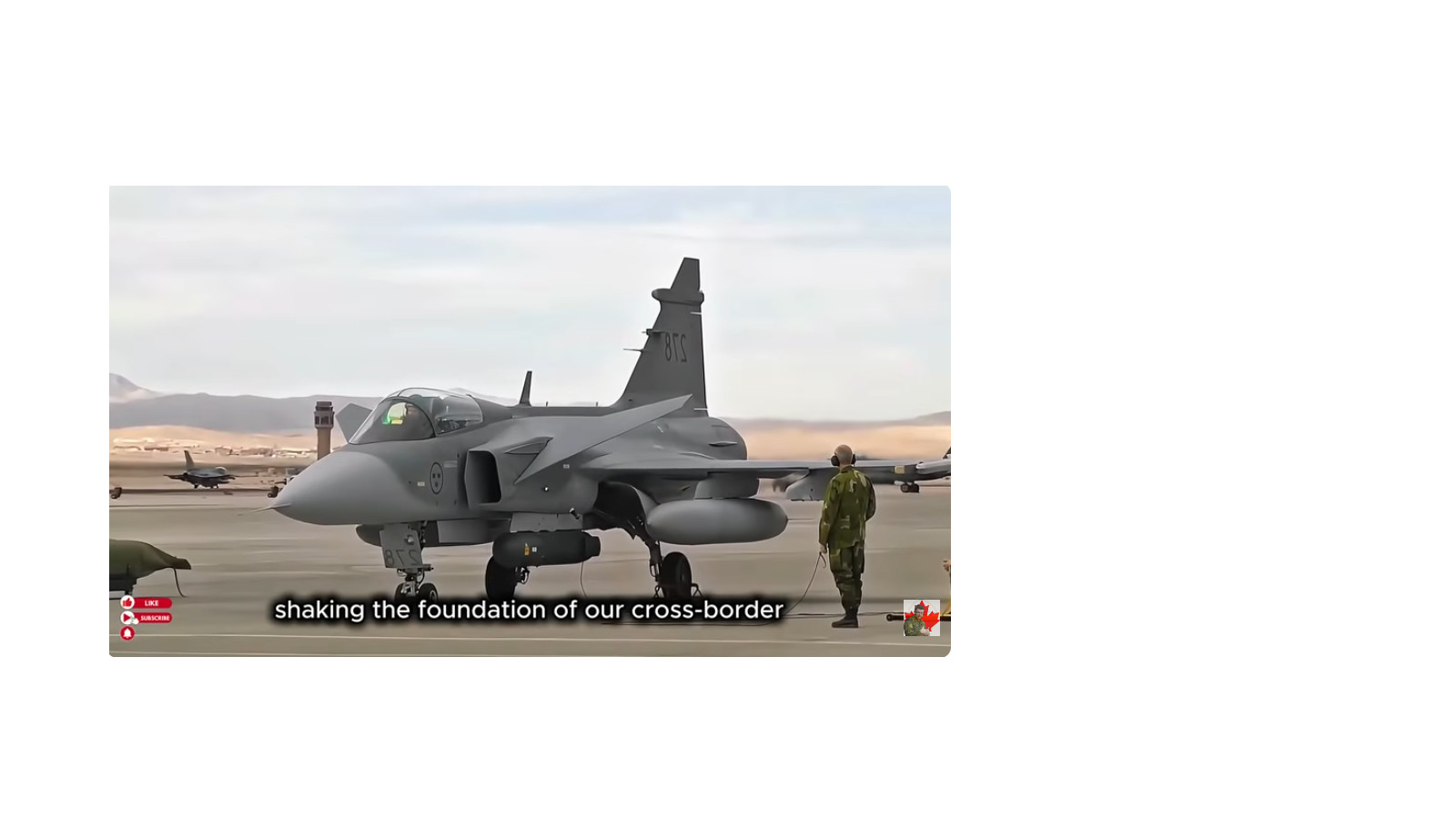
America's Nightmare Rolls Royce Joins Canada’s Gripen Bid
DEFENSE STRATEGY ... NavyCast
America's Nightmare Rolls Royce Joins Canada’s Gripen Bid
Original article: https://www.youtube.com/watch?v=37M0-sFfM2g
NavyCast
Dec 4, 2025
1.49K subscribers ... 4,837 views ... 200 likes
HOA KỲ
#gripen #rcaf #canadadefense
Canada stands at a defining moment in its military history. In this in-depth analysis, we explore why the Saab Gripen has re-emerged as a serious contender against the American F-35 to replace our aging CF-18 fleet. The game-changer? A proposal for a Rolls-Royce engine that could liberate Canada’s air defence from restrictive US export controls and supply chain dependency. We examine how a British-powered Gripen offers more than just agility; it offers true national sovereignty and a chance to heal the industrial wounds left by the Avro Arrow cancellation.
We break down the strategic advantages of the Gripen for Arctic operations, where dispersed basing and cold-weather reliability are critical for the Royal Canadian Air Force. Beyond the cockpit, we analyze the economic impact of domestic production, potentially revitalizing aerospace jobs in Quebec and Ontario. Is the high cost of the F-35 worth the loss of autonomy, or is the Gripen the pragmatic choice for a middle power asserting its independence? Join us as we dissect the geopolitics, economics, and technical specs of this multi-billion dollar decision.
If you value independent Canadian defence analysis, please like this video and subscribe to our channel for more updates.
#gripen #rcaf #canadadefense #militaryanalysis #cdnpoli
How this was made
Altered or synthetic content
Sound or visuals were significantly edited or digitally generated. Learn more
Peter Burgess COMMENTARY
Peter Burgess
Transcript
- 0:00
- If you followed defense news casually, scanning the headlines over your morning coffee, you might have glanced at the
- recent updates regarding Canada's search for a new fighter fleet and thought little of it. On the surface, it appears
- to be a standard, perhaps even mundane military procurement story. You hear
- that Ottawa is reconsidering its commitment to the American F-35 Lightning 2. You hear that Sweden's Saab
- Grippen is back in the conversation with renewed vigor. And suddenly, the legendary British engineering firm
- Rolls-Royce is being discussed as a new engine supplier. To the uninitiated,
- this looks like just another round of international lobbying. The usual bureaucratic shuffle of papers and
- political back and forth that has defined Canadian procurement for decades. However, when you look
- underneath it, when you really peel back the layers of this developing narrative, you start to realize that this is not
- 1:11
- mainly a story about airplanes at all. It is not simply about thrust to weight ratios, radar cross-sections, or the
- technical specifications of a machine. This is a story about power. It is a story about control. Most importantly,
- it is a story about how economic relationships shape national sovereignty
- and whether Canada is finally ready to stand on its own two feet. For those of us who have lived in Canada through the
- shifting tides of the last few decades, this story touches our lives more directly than we might think. What looks
- like a debate over two fighter jets, the 88 aircraft we have pledged to buy, is
- actually a referendum on who gets to decide the future of Canada's defense policy. It is a question that asks
- whether we are content to remain a junior partner in our own defense or if we are prepared to reclaim the autonomy
- that defines a truly sovereign nation. When we examine this situation through an economic lens, the stakes become
- crystal clear. we begin to see how deeply the United States has tied its military technology to political
- leverage and how countries like Canada have historically struggled to navigate that dependency. For generations, the
- 2:06
- assumption has been that our security is inextricably linked to American industry. But moments like this, where a
- new variable enters the equation, have the power to either reinforce long-standing hierarchies or weaken them
- to our advantage. You might be asking yourself why a single engine manufacturer Rolls-Royce even matters
- here. How can a change in a supplier change the destiny of a G7 nation? The
- answer lies in the fact that engines in modern defense procurement are not just machinery. They are instruments of
- policy. They are the heartbeat of the aircraft. Yes, but they also determine who controls maintenance, who controls
- upgrades, who controls export rights, and in some critical cases, who controls
- whether a jet can even be deployed in certain geopolitical scenarios. These are not mere technical details to be
- buried in a contract. These are political choke points. To understand the magnitude of the opportunity now
- 3:03
- before us, we must lay out the situation as clearly as possible. Canada had already started down the road toward
- buying 88 American F-35 fighters, the flagship of the US military-industrial
- complex. Billions of dollars had already been committed, and Washington fully expected Canada to fall in line, just as
- it has for decades. NATO officials saw it as the predictable outcome for a country that has historically aligned
- its military decisions with American expectations. It was, for all intents
- and purposes, a done deal, a continuation of the status quo, where Canada buys American, flies American,
- and ultimately relies on American permission to operate. But politics,
- much like the Canadian weather, has a way of transforming what looked inevitable into something uncertain. A
- trade conflict with the United States erupted, shaking the foundation of our crossber relationship. We watched as
- tariffs, threats, and hostile rhetoric from the administration of Donald Trump created tension and embarrassment for
- 4:06
- the Canadian government. It was a stark reminder that even the closest of allies can become unpredictable. Suddenly, the
- F-35 contract, which had once been pitched to us as a symbol of unwavering
- partnership, started looking less like a shield and more like a symbol of vulnerability. If our neighbor could
- weaponize trade tariffs against our steel and aluminum industries overnight, what guarantee did we have that they
- wouldn't weaponize the supply chain of our national defense? Into that newly opened space stepped Sweden's Grippen, a
- jetl long seen as an underdog in North American procurement. For years, the Grippen was viewed as a capable but
- ultimately secondary option, primarily because it too relied on a US-made engine, the GEF414.
- This meant that even if Canada bought a Swedish jet to diversify its fleet, we would still remain tethered to American
- 5:01
- export rules and US political permission. That dependence was always the Achilles heel of the Grippen
- proposal. It was the invisible string that kept Ottawa tied to Washington. Regardless of whose flag was painted on
- the tail of the aircraft, now comes the twist that should make every Canadian sit up and take notice. Rolls-Royce has
- entered the conversation with the possibility of supplying a British engine for the Grippen E. This is not a
- minor adjustment. It is a strategic revolution. If this proposal moves forward, the Grippin becomes not just a
- competitor to the F-35 in terms of performance or cost, it becomes a competitor in sovereignty. Think about
- what that means for a moment. If Canada flies a British powered Grippen, it is
- no longer bound by US export controls. It does not need Washington's approval to maintain the aircraft, to upgrade its
- software, or to integrate new weapon systems. its supply chain becomes insulated from US political swings and
- 6:00
- the whims of whichever administration happens to occupy the White House. In a world where American politics have
- become increasingly volatile, where tariff threats and America first policies can appear overnight, that kind
- of independence is not a luxury. It is a strategic asset of the highest order.
- This development speaks to a deeper yearning in the Canadian psyche. Particularly for those of us aged 40 to
- 65 who remember a different era. We remember the stories of the Avro Arrow. We remember 1,959.
- For decades, the cancellation of the Arrow has haunted our national imagination. Not just as a loss of a
- beautiful aircraft, but as the moment we seemingly seated our aerospace ambition to the United States. It dismantled an
- entire industry, scattered thousands of our brightest minds to NASA and other US
- firms, and fed a lingering sense of national loss that still sits just beneath the surface of our collective
- memory. Whenever Canadians hear talk of building advanced aircraft domestically, it is impossible not to think of that
- 7:05
- white bird that never truly got to fly. The Arrow wasn't just a jet. It was a symbol of what Canada could achieve
- independently. Worldclass technology, homegrown innovation, and a defense capability that was second to none. The
- prospect of the Rolls-Royce powered Grippin reawakens that dormant dream. Why? Because this isn't just about
- buying a plane off the shelf. Sweden's proposal involves manufacturing these fighters right here on Canadian soil.
- This is a moment where countries around the world, Canada included, are asking themselves a simple but profound
- question. Is it wise to place so much of their national defense, their industrial
- stability, and their political autonomy in the hands of a single superpower? Canada's geographic reality only deepens
- the stakes. We are the second largest country on Earth with a coastline that is the longest in the world and an
- Arctic territory that is becoming increasingly contested. No other western country has to defend such vast Arctic
- 8:05
- territory with such extreme temperatures. Our jets must take off from icy runways in Anuvic or a
- Callowit, fly enormous distances without constant aerial refueling, and survive
- conditions that push machines to their absolute limits. Sweden, a northern nation itself, designed the Grippin
- precisely for that kind of environment. It was built for dispersed operations,
- capable of taking off from highway strips and being serviced by a small crew of conscripts in the middle of a
- frozen forest. But what made it complicated for Canada in the past, what kept it tied to US oversight was that
- American engine. A British engine breaks that chain. And that shift is not some
- small technical improvement. It rewrites the rules of who has influence over Canadian defense strategy. That is why
- the debate between the F-35 and the Grippen has escalated so rapidly. It is
- because this isn't only about technology or cost overruns or maintenance schedules. This is about who Canada
- 9:05
- wants to be in a shifting geopolitical landscape. Do we want to repeat the patterns of dependence that dominated
- the last century? Do we want to lock ourselves into a system where we are merely a client state paying billions
- for the privilege of accessing a supply chain we do not control? Or do we want to begin writing a different story for
- the next century? A story where Canada stands as a partner certainly, but an independent one capable of making its
- own decisions, servicing its own fleets and charting its own course through the turbulent skies of the 21st century.
- Now, to understand how we got here, we have to look at the long arc of Canada's
- relationship with the United States. For decades, the economic logic of North
- American defense has been remarkably simple, perhaps deceptively so. The US
- builds the most expensive and technologically ambitious platforms and its closest allies buy them. The allies
- 10:02
- get advanced capabilities. And the US gets something far more important than money. It gets influence. It gets
- dependency. It gets the ability to shape the policies and strategic decisions of partner countries without ever having to
- say it openly. You might think of it as a kind of insurance policy for American geopolitical leadership. But from the
- perspective of a country like Canada, it is also a constant reminder that autonomy has a price. Every time Canada
- buys an American system, it is also buying a degree of American oversight. The F35 program is the clearest example
- of that dynamic. It was marketed to us as an affordable futureproof solution, a
- joint strike fighter that would unify the West. But the reality turned out very differently. Costs rose far beyond
- early projection. Maintenance became a long-term burden that would stretch well into the 2007s.
- And the jet's stealth capabilities, while undeniably impressive and vital for certain first day of war scenarios,
- 11:04
- come with massive logistical demands. You, as a taxpayer or a worker, may
- never step foot inside one of these aircraft. You may never see the inside of a cockpit or feel the G forces of a
- supersonic turn. But make no mistake, you will pay for it. You will pay for it
- through government budgets that prioritize foreign procurement over domestic investment. You will pay for it
- through industrial trade-offs where Canadian companies are relegated to supplying parts rather than building
- systems. And you will pay for it through the opportunity costs of public money that could have gone somewhere else to
- healthcare, to infrastructure, or to revitalizing our own manufacturing sector. That is the economic truth
- behind all large defense purchases. They are not just technical choices. They are
- fiscal and structural choices that shape a country's manufacturing base, its
- 12:00
- workforce, and its political economy for decades. Now, imagine this happening at
- the same moment when US Canada relations are being tested by trade conflicts and
- political divergence. Tariffs are being threatened on our lumber and steel. Public insults have been traded across
- the border. American political volatility is spilling over, affecting everything from investment flows to
- border security. In that environment, any responsible government in Ottawa is going to ask itself whether locking in
- tens of billions of dollars with a single supplier, one whose leadership has proven unpredictable is a wise
- decision. That is the backdrop that made the Griffin rise from a long shot to a serious contender. But there is another
- layer here that I want you to think about. A layer that speaks to the very heart of our national identity. Defense
- procurement is not only about buying machines. It is about building industries. When Sweden offers to
- produce Grippon aircraft inside Canada utilizing Canadian labor and Canadian facilities, that is not a courtesy. That
- 13:03
- is an economic strategy. It means jobs, high-paying, high-tech jobs in Quebec,
- in Ontario, and across the supply chain. It means regional investment and technological development that stays
- within our borders. Given the painful memory of the Avro Arrow, that abandoned
- Canadian aerospace dream that still lives in the national imagination, the idea of building a modern fighter at
- home carries enormous emotional and economic weight. It feels like a moment
- to reclaim something that was lost in 1959. It feels like a chance to revive an industry that once stood among the
- best in the world. We were the country that built the third largest navy in the world by the end of World War II. We
- were the country that designed the Arrow, a jet that was decades ahead of its time. We have the talent. We have
- the history. The question is, do we have the will? But even here, the economic
- reality is complicated. We must be honest with ourselves. Bombardier has a history of both remarkable innovation
- 14:04
- and costly failures. The C series became a global success as the Airbus A220,
- proving our engineering genius, but not before nearly bankrupting the company and requiring government intervention.
- Other programs collapsed under financial pressure. Building a fighter jet, one of the most complex machines on Earth,
- would require a level of discipline that our domestic industry has struggled to maintain consistently. So, while the
- possibility of domestic production is enticing, it comes with serious questions about risk management and
- long-term sustainability. However, we must weigh this risk against the certainty of the F-35's challenges. The
- F-35's issues are not hypothetical. They are already well documented. rising
- prices, long maintenance times, and a lifetime cost per aircraft that is
- stretching the limits of what Canada can reasonably afford. And here is where you, the viewer, and the taxpayer really
- 15:04
- feel the economic consequences. Money spent on expensive procurement is money
- not spent on housing, health care, infrastructure, and education. It is
- money that shapes the choices available to your community, your taxes, your job
- prospects. That is why these debates matter. Not because most of us will ever
- see one of these jets up close, but because the macroeconomic choices behind them ripple down into everyday life. The
- Rolls-Royce engine changes the calculus of this risk. It suggests that we can have domestic production and strategic
- independence. It suggests that we can partner with the United Kingdom, a traditional ally with whom we share deep
- historical roots, and Sweden, a fellow northern nation, to create a solution
- that is uniquely Canadian. The GEF414 engine ties the Grippin to the United
- States. Rolls-Royce would cut that tie. And once that dependency is removed, the
- 16:04
- entire political logic of the competition changes. Suddenly, Canada is not deciding between two aircraft. It is
- deciding between two strategic futures. One where American oversight continues to shape its military posture for the
- next 40 years and one where Canada gains breathing room by aligning more closely with Britain, Europe, and its own
- domestic capabilities. This is the end of part one. In the next section, we will delve deeper into the specific
- mechanics of the supply chain power, the safety debates regarding single versus twin engines in the Arctic, and how the
- massive demand from Ukraine up to 150 jets might just be the catalyst that
- turns Canada into a global aerospace manufacturing hub once again. To truly
- grasp why this shift in engines is a watershed moment, we must move beyond the boardroom rhetoric and examine the
- gritty mechanics of how power operates in a modern market economy. When a nation buys a fighter jet in the 21st
- 17:03
- century, it is not simply purchasing a machine. It is entering into a marriage. It is a long-term economic arrangement
- involving spare parts, software source codes, training protocols, repair contracts, and weapons integration. The
- seller controls the flow of these vital components. And as any student of history or economics can tell you, that
- control is worth far more than the sticker price of the aircraft itself. Think of it in terms that every Canadian
- homeowner or car owner understands. If you buy a high-end luxury vehicle, the
- dealership might make a modest profit on the initial sale, but the real revenue
- and the real control comes from the years of proprietary servicing. the specialized diagnostic computers that
- only they possess and the parts that must be shipped from their factory. You cannot take that car to your local
- mechanic. You are tethered to the dealer. Now multiply that logic by
- several billion dollar and add the weight of geopolitical leverage on top
- 18:03
- of it. That is the business model of the modern military-industrial complex. So
- when Ottawa considers the F-35, what it is really considering is a decadesl long
- dependence on American supply chains and American intellectual property. This is
- why the United States pushes so aggressively for its allies to join the program. Every country that invests in
- F-35 components becomes economically and militarily integrated into US defense
- policy. It is not simply about selling jets. It is about maintaining an ecosystem where American companies,
- American regulations, and American diplomacy sit at the absolute center.
- From Washington's perspective, this is brilliant statecraft. It ensures that
- any country flying the F-35 is deeply woven into US military priorities,
- whether they fully realize it or not. Now, contrast that with the vision of a Rolls-Royce powered Grippen. Suddenly,
- 19:03
- the United States loses those levers of control. Sweden gains autonomy over its
- exports. Britain gains a significant foothold in an aerospace industry long
- dominated by the US giants. And most importantly, Canada gains the ability to
- make sovereign decisions about its airfleet without waiting for a stamp of approval from the State Department in
- DC. That is why the engine question matters so profoundly. A change in the
- manufacturer is not just an engineering decision. It is a shift in political gravity. It moves the center of our
- strategic world from a unipolar dependence on Washington to a multilateral partnership with Europe and
- the Commonwealth. Let us also look at how this plays out in the real world economics of our specific geography. The
- F-35 requires a complex heavy infrastructure for operations. specialized climate controlled hangers,
- expensive maintenance equipment, highly trained technicians with specific security clearances, and constant
- 20:03
- connection to the Alyss logistics network. All of that means astronomical long-term costs. And those costs are
- passed directly to you, the taxpayer. Meanwhile, the Grippin was built for a
- different philosophy, one that resonates deeply with the Canadian reality. Sweden designed it for the cold. They designed
- it for dispersed bases hidden in forests and remote roadways, anticipating a scenario where major air bases might be
- destroyed in the first hours of a conflict. A small crew of conscripts led by a single technician can replace the
- engine in under an hour outdoors in the snow. It can take off from short icy
- roads. It requires far less maintenance per flight hour. These are not small technical differences. They reflect two
- totally different economic models of air defense. One is centralized, highcost
- and technologically layered. A Ferrari approach suited for projecting power globally. The other is decentralized,
- 21:03
- flexible, and affordable. A Land Rover approach suited for defending a vast rugged homeland. For a country like
- Canada with tight budgets and an Arctic frontier that stretches beyond the horizon, the economic structure of the
- Grippen fits our reality more naturally than the demanding ecosystem of the F-35. However, the debate is never
- one-sided, and we must address the safety argument that F-35 supporters wield with great effect. They argue that
- the Grippen is a single engine aircraft and that for Arctic patrols, two engines are safer than one. It is a valid
- concern that resonates with anyone who has driven a car on a lonely winter highway. But the F-35 is also a single
- engine aircraft. The difference is that its entire design is built around minimizing risk through layers of
- high-end technology and remote monitoring. Critics of the Griffin argue that when you are flying over frozen
- seas in the dead of winter, hundreds of kilometers from the nearest settlement, a backup engine offers psychological and
- 22:05
- practical reassurance. Yet, since neither of the primary contenders offers a twin engine design, the debate shifts
- to reliability versus redundancy. The Griffin's proponents argue that it has
- an exceptional safety record and crucially, its simplicity makes it less
- prone to the complex systems failures that can ground more advanced jets. Here
- again, the economic dimension appears. Safety is not just a technical choice.
- It is a budget choice. Twin engine fighters are significantly more expensive to build, fuel, and maintain.
- So countries must weigh the cost of redundancy against the probability of failure. This is how capitalism shapes
- military decisions. It turns safety into a costbenefit calculation. It turns
- sovereignty into a supply chain issue. And it turns industrial development into a bargaining chip. And then we reach the
- 23:00
- political tension that makes this moment so volatile. When Donald Trump escalates a trade war with Canada, imposing
- tariffs on steel or aluminum, it does not just affect commodity prices. It affects how Canada evaluates the
- reliability of the United States as a long-term partner. If tariffs can be used as political weapons to force
- concessions on dairy or lumber, then so can export controls on jet engines or mission software. The mere possibility
- of that creates a rational incentive for Canada to explore alternatives. This is
- not anti-American sentiment. This is prudent risk management. This is what
- sovereign countries do when the stability of their primary partner becomes uncertain. This brings us to a
- potential maiden Canada compromise that analysts are beginning to whisper about. There is a scenario where Canada could
- keep the small number of F-35 seconds it has already committed to perhaps the 16
- aircraft originally discussed to maintain high-end interoperability with NATO for specific missions while
- 24:02
- supplementing them with a much larger locally produced fleet of Grippins. This
- mixed model would balance high-end capability with affordability and independence. It is a strategy that
- attempts to satisfy NATO expectations while acknowledging domestic political and economic constraints. And it
- reflects a growing recognition that no single supplier, not even the United States, should hold all of the keys to a
- country's defense posture. But as we zoom out from these technical debates, I want you to see the wider implications
- that stretch far beyond a procurement review. What is unfolding in Canada is part of a larger realignment happening
- across the Western world. For decades, the United States held a near monopoly
- on advanced defense systems among its allies. That monopoly wasn't accidental.
- It was built deliberately, piece by piece, through export controls,
- licensing agreements, and intellectual property rules that ensured any country
- 25:02
- buying American equipment would remain economically tethered to Washington's decisions. That structure has worked
- remarkably well for the US. But in a moment where American politics has become unstable, where alliances get
- questioned depending on the election cycle, countries have begun reconsidering whether tying their
- national security so tightly to one supplier is still wise. And that is the
- hidden story behind the rise of the Grippen in Canada. It is a symptom of something much bigger. The search for a
- more multi-olar defense economy. Countries are looking for options that hedge against volatility. They are
- looking for ways to reduce the risk that their defense capabilities could be disrupted by political conflict. And
- when you think about it, this is not so different from how ordinary Canadian families behave. If you had a job where
- your entire retirement depended on the mood swings of a single boss, you would start diversifying your income streams.
- Countries are doing the same thing, but on a geopolitical scale. Now consider the Ukraine factor, a new variable that
- 26:06
- has turbocharged the demand for these aircraft. Ukraine has expressed a strong interest in acquiring up to 150 gripins
- because they need a jet that is tough, easy to repair, and doesn't need a pristine runway. This massive potential
- order changes the industrial math completely. Sweden alone cannot produce
- that many jets quickly enough. They need a partner with industrial capacity, skilled aerospace workers, and a safe
- geographic location far from the range of Russian missiles. Does that sound familiar? Canada is the perfect
- candidate. Building part of that capacity here solves multiple problems at once. It gives Sweden the output it
- needs. It provides Ukraine with the lifeline they are desperate for. And it gives Canada a revitalized aerospace
- sector that isn't just assembling parts but building complete airframes. This is
- the kind of alignment that rarely happens by accident. It reflects a broader pattern in global capitalism
- 27:05
- where production moves to places that satisfy both political and economic constraints at the same time. For Prime
- Minister Justin Trudeau or perhaps a future Prime Minister Mark Carney, the decision is fraught with competing
- pressures. They are caught between a trade dispute with a protectionist US administration, a public skeptical of
- rising defense costs, and NATO allies who expect Canada to share the burden of collective security. Every decision made
- here is shaped by these competing economic pressures, the pressure of budgets, the pressure of geopolitical
- commitments, the pressure of industry lobbying, and the pressure of public sentiment. But let us return to the
- voice of the worker, the engineer, and the citizen. When we look at the situation through the lens of the
- Canadian middle class, the classes and groups within our society, the picture clarifies. Defense contractors and
- aerospace workers in Quebec and Ontario see a once-ina-lifetime opportunity in
- 28:02
- domestic production. They see a future where their children don't have to move to California or Texas to work on the
- cutting edge of aviation. Taxpayers see the risk of cost overruns, yes, but they
- also see the value of tax dollars circulating within the Canadian economy rather than flowing south. Northern
- communities see a jet that is actually built for their reality, not one imposed
- upon them. Diplomats see the implications for relations with Washington, certainly, but they also see
- the respect that comes from self-reliance. And ordinary workers see a government navigating a trade war
- while trying to maintain economic stability. None of these perspectives are wrong. They reflect the complexity
- of a decision that blends economics, security, sovereignty, and history into
- one tangled knot. And this is precisely why the debate feels so charged. It is
- not simply a question of which jet is better, faster, or stealthier. It is a
- question of what kind of nation Canada wants to be in a century defined by shifting power dynamics, unpredictable
- 29:06
- politics, and global economic uncertainty. Are we a nation that waits for instructions, or are we a nation
- that builds its own shield? The arrival of Rolls-Royce in this conversation marks a pivotal moment because it
- unlocks the door that has been bolted shut since 1959. It signals that alternatives exist. It
- signals that the US no longer has uncontested dominance over our strategic choices. And it signals that Canada has
- options, real viable options in shaping its own future. We have the skilled
- labor. We have the factories. We have the Arctic imperative. And now, thanks
- to the British engine proposal, we have the political pathway. The ghost of the Avro Arrow has hovered over this country
- for too long, serving as a reminder of what we gave up. Perhaps, just perhaps,
- the roar of a Rolls-Royce engine in a Canadian-built airframe is the sound of
- 30:03
- that ghost finally being laid to rest. It is the sound of a country realizing that while we cannot change the past, we
- have the absolute power to manufacture our own future. The question is no longer can we do it. The question is, do
- we have the courage to choose ourselves? If this vision of a sovereign Canadian future resonates with you, please take a
- moment to like this video and subscribe to the channel. It truly supports our mission to bring these important
- national conversations to light. I would love to read your perspective in the comments below. First, do you believe a
- made in Canada Griffin fleet could finally heal the legacy of the Avro Arrow? Second, is strategic independence
- from US supply chains worth the trade-off in stealth capabilities? And finally, would you feel more secure
- knowing our Arctic is guarded by jets built specifically for the North? Thank you for your time. Stay safe and take
- care,