
Date: 2026-04-22 Page is: DBtxt003.php txt00029227
COMMENTARY
THE COFFEE KLATCH ... NOVEMBER 29TH 2025
with Robert Reich and Heather Lofthouse
Trump's Thanksgiving Tirade
THE COFFEE KLATCH ... NOVEMBER 29TH 2025
with Robert Reich and Heather Lofthouse
Trump's Thanksgiving Tirade
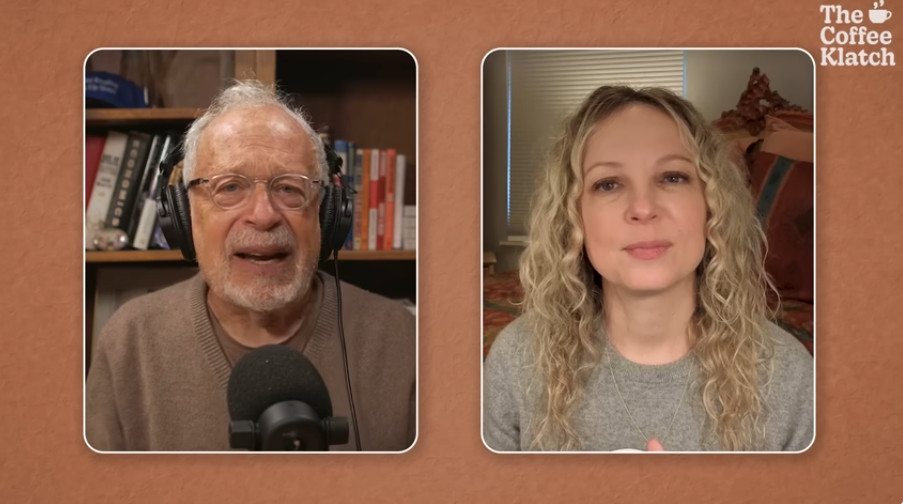
Original article: https://www.youtube.com/watch?v=kUgvph_CdJc
Robert Reich
Premiered Nov 29, 2025
1.39M subscribers ... 127,356 views ... 7.7K likes
The Coffee Klatch with Robert Reich
- What does Thanksgiving really represent today?
- Is our Divider-in-Chief actually bringing Americans closer together?
- Is the choice for Democrats really “woke” vs. economic populism?
Peter Burgess COMMENTARY
Peter Burgess
Transcript
- 0:02
- And it is the Saturday coffee clutch with Heather Loft House uh on the east coast and here I am yours truly Robert
- Raj on the west coast. We have America covered Heather. Heather, how was your Thanksgiving? What
- are we going to talk about today? Thanksgiving. Thanksgiving. So this is a special episode of us drinking coffee which we
- do every week. This one's about let's talk turkey. Let's talk the price of turkey. Let's talk who went to who sat
- at Trump's Thanksgiving table, how what he's done to Thanksgiving, what it means to us.
- I you know, I uh let me just start. I I had a wonderful Thanksgiving. I love
- Thanksgiving. It's my favorite holiday. I love getting my relatives and and you
- know, just everybody together over a a meal. I don't think I about you. This is your
- favorite holiday. I didn't know that. It's my favorite. I mean, when I was a kid, I loved Thanksgiving because on
- both sides of my family, uncles and aunts and grandparents all came together and uh it was just marvelous. It was
- 1:03
- just wonderful feeling. And I had one grandmother who was a great cook and one grandmother who was a terrible cook. And
- the great cook actually was responsible for Thanksgiving. God. And uh and I was not aware of any family
- tensions. I mean, I'm sure that where every family has tensions, but I just, you know, as a little kid, I just basked
- in being the little kid, right? Or one of the little kids. That's so fun. I love that for you. Um,
- and you had a sibling, right? So, did you have cousins come over? Was it big and boisterous? And cousins. Oh, yes. A lot of cousins.
- And we had every year we because my one of my great uncles was a photographer. So every year the the kind of the big
- moment of Thanksgiving was everybody getting together for the Thanksgiving photograph and Uncle Morris got
- everybody together and so every so we had photographs you know 20 or 25
- Thanksgiving photographs. We don't have any to show right and you can see everybody growing. I
- 2:04
- mean I didn't grow very much but everybody grows and changes and uh it's
- it's it was lovely. It really was lovely. I think that's fabulous. My Thanksgiving has been terrific. So, it was fun to be
- in Manhattan because we got to go on the outskirts of the Thanksgiving Day parade. I mean, we didn't go into the
- mayhem. Um, but so that was that Thanksgiving parade is that with the big balloons, the gigantic
- floats. Gigantic floats. Floats. Yes. They're not balloons, they're floats. Yeah. We have picture of my kid in front
- of Minnie Mouse. We have picture of my kid in front of Paw Patrol. And meanwhile, he's 13 and doesn't care.
- Didn't Macy's start that? Yeah. And they Wasn't originally Macy's? Yeah. Really? It's still the Macy's
- Thanksgiving Day Parade? Yeah. It's on NBC and Peacock. And no, I'm not getting paid by them. I wonder why no other cities do big
- Thanksgiving parades like big and best. Yeah. No one can compete.
- But I mean, what why isn't there in here on the West Coast? There's I don't know if any Monopolies. Monopolies, Bob.
- 3:05
- Yeah. Yeah. Maybe it is. Maybe it is Monopoly. So, but I So, my childhood Thanksgivings
- where I would go to my dad's and they were very small, but now it's like I try to do I mean, we we should talk about
- this, right? And that post you did yesterday on Substack and what does Thanksgiving mean? It means so much to
- so many different people. And I feel like we all learned or I did at least this kind of version sanitized version
- of pilgrims and native people and shaking hands and sharing bread and you
- know I mean there's some there's some real conflict around this holiday. But I do believe in the gratitude stuff. Not
- just my own little list that says you know I'm really grateful that the corn on my toe is gone and blah blah blah but
- more I'm grateful for you and Wait a minute. You're grateful that the corn on your toe being a tribute. The
- first Thanksgiving was about corn. It was about corn, but it wasn't about the corn on your toe. It was about It was
- 4:03
- about the in now the Native Americans provided corn to the pilgrims. No.
- And I remember exactly where on Cape Cod. I used to visit it all the time where they met. Yeah. First, it was
- called First Encounter Beach. And yes, it there was a lot of mythology around it, but I was, you know, as a kid, I was
- just I was just really enthralled to be at the spot where the pilgrims met the
- Indians or the Native Americans, we used to call them Indians and they exchanged gifts and they were all, you know,
- according to the mythology, everybody was was lovely, right? But that's a real myth that we
- are real good in America at making and continuing even and it seems hiler
- I loved it. I did. I also, as I published yesterday, that painting, you
- know, the Norman Rockwell painting of that Thanksgiving, which was, you know,
- the middle class Midwestern Norman Rockwell, Lily White, uh, everybody is
- 5:06
- there around the Thanksgiving table with this gigantic turkey. Um, but that was from n that was from the Saturday
- Evening Post. U He Heather, I don't know if you remember that magazine. I don't remember. used to be very
- it was very popular and Norman Rockwell published that the Saturday Evening Post
- published his painting uh which has become the iconic Thanksgiving painting
- uh published it in 1940 I guess it was the right during the war uh but it was
- called freedom from want. It was one of the four paintings that Norman Rockwell
- did uh to celebrate uh the four freedoms
- that Franklin D. Roosevelt had talked about in his 1941 State of the Union address.
- The first is freedom of speech and expression
- 6:03
- everywhere in the world. The second
- is freedom of every person to worship God in his own way everywhere in the
- world. The third is freedom from want
- which translated into world terms means economic understandings
- which will secure to every nation a healthy peacetime life for its
- inhabitants everywhere in the world.
- The fourth is freedom from fear
- which translated into world terms means a worldwide reduction of armament
- to such a point and in such a thorough fashion that no nation will be in a
- 7:06
- position to commit an act of physical aggression against any neighbor anywhere
- in the the 1941 State of the Union. Clearly, Franklin D. Roosevelt wanted America to
- get involved and we were in the middle of Len lease. We were giving taxpayer
- dollars and and in many ways 1941 reminds me of today in the sense of the
- darkness overcoming the world, the dictators. I mean, look what Putin has
- tried to do in Ukraine or Netanyahu in Gaza. Uh now if you believe that Trump
- is on the way to holding those dictators feet to the fire uh you know you are
- more naive than even I am. Hopefully we will see peace. But the
- problem is, as we saw with Neville Chamberlain in 1938
- 8:04
- when he tried to appease Hitler, you can't appease a tyrant. And you can't
- expect that a tyrant who is appeased is going to continue
- to go into the night peacefully. No. In fact, appeasement incites tyrants.
- That's why it's so important to stop Putin in his tracks. And you saw Witoff
- basically advising Putin on how to deal with Trump.
- I, you know, talk about treachery. Talk about somebody being a traitor. I mean,
- how you these people are working for us, Heather. I keep on reminding myself they
- are public servants. What does it mean to be a public servant? It means that they are in fact our employees. We are
- their bosses to do what they're doing uh runs so roughshot over the ideals of
- 9:01
- self-government. Freedom means the supremacy of human rights everywhere.
- All our support goes to those who struggle to gain those rights and keep
- them. Our strength is our unity of purpose.
- to that high concept there can be no end
- save victory as the you know as the world is is is in
- the shadow the darkening shadow of these dictators uh the you know the imperial
- Japan and Hitler and Mussolini u and uh the United States still was isolationist
- But it was a very very frightening time. But I do. So he mentioned the four
- freedoms and then my understanding is that Rockwell went he said I want to give something. I'm an illustrator. And
- 10:04
- he went to DC and he talked to the department of war and he said, 'What can I do?' And they said, 'Oh, we did
- illustrations last time. We're doing artists this time.' And so he said, 'Fine. I'll go back to my, you know, standard job.' and she went to the
- Saturday Evening Post and they said, 'We'll do these four freedoms and we'll post each one with an essay with it.' I
- do think the painting's so interesting because I do on the one hand I think it's been co-opted into this perfect
- white Thanksgiving. But he's so interesting if you study more about him, the people he was with, his second wife
- who was around that table. It was a family that he had made, right? It was a chosen family. It was lots of
- How do you know so much about I didn't know you were a Norman Rockwell fan. So, I interned at the museum. I'm kidding.
- No, I Googled it. Hello. Anyone can be an expert on anything in 2025, except that most people aren't. Um, but I think
- it's so interesting that he he was way more progressive than I think people
- 11:00
- believe when you just see that painting and you just think, oh, but then when you read it with the essay. So, can you
- talk a little bit about the essay that he that was published next to the painting and that you put up on Substack? It was the Saturday Evening
- Post asked this um immigrant from the Philippines uh a Filipino American named
- Carlos Bulisonan uh to write an essay. He was a poet and
- a novelist and an activist Bulisonan. He was a labor organizer. Uh they asked him
- to write an essay about freedom from want. and uh not you know in contrast to
- Norman Rockwell's cover it was a very moving essay about being an immigrant in
- the United States at that time uh and you know he said we do not take
- democracy for granted we feel it grow in our working together many millions of us
- working toward a common purpose if it took us several decades of sacrifices to
- 12:01
- arrive at this faith it's because it took us that long to know what part of America is ours. Uh and then he goes on,
- I won't bore you with the whole point, but he says, 'Our faith has been shaken
- many times and now it is put into question. Our faith is a living thing
- and it can be crippled or chained. It can be killed by denying us enough food
- or clothing or blasting away our personalities and keeping us in constant
- fear. Now obviously the relevance of all this to what's
- going on today is cannot be avoided. Uh and which is why I chose that particular
- essay. And I also think I mean that's why that's the good side of the internet. you posted that and then I went down a
- rabbit hole of you know what was all of this and I love the last line. And so he was also a poet um the author of this
- 13:00
- essay. And so his last line was something like do you want to know what
- we are? We are marching. Or do you want to know what we want? We are who we are. Something like that. We are marching.
- And I love that last line because it's so proactive. And so you think of this
- freedom from is an interesting concept, right? When you're deci when you're defining something that's the absence of
- something, it's kind of hard to grasp. And so then you have Rockwell doing this bounty at this table and smiling white
- folks. Um but I bet Rockwell liked that essay a lot and I loved the essay was
- full of hope. Um yes and and and the four freedoms you're absolutely right. The four freedoms one
- is freedom uh from want uh and the other is freedom from fear. It's not just
- freedom of speech and freedom of religion. Freedom from want and freedom from fear. uh and these uh became very
- central to the United States understanding of why we went to war, when we went to war, what we were
- 14:03
- fighting for, not just freedom of speech and freedom of religion, but also freedom from want and freedom from fear.
- uh and then the four freedoms got incorporated into the UN charter uh into
- the uh you know subsequently into the declaration of human rights in 1948. I
- mean they were they were palpable after the war. I mean the United States felt that we had conquered justifiably we had
- conquered dictatorship. We had you know freedom and democracy had won. uh and
- and and we celebrated we celebrated these four freedoms. And then of course Rockwell did that
- painting about um Ruby Bridges and the desegregation of schools that was so powerful.
- He was interesting through painting he conveyed he reminds me a little bit of Frank Capra.
- You know Frank Capra who who was the director who did uh you know it's a wonderful life and Mr. Smith goes to
- 15:05
- Washington and was accused of being corny about American values. They called
- him Capraorn. But Norman Rockwell and Frank Capra in
- some sense uh in the 1940s, 1950s encapsulated
- America's idea of what its ideals actually were, right? That they were universal ideals. They
- were universal ideals about democracy, about the rule of law, about uh about
- the centrality of these human values. And uh think how far we've come.
- And so we have FDR talking about these four freedoms and then now we have Mayor
- elect Mumdani in Manhattan, in New York, um in Brooklyn, wherever he actually is.
- I don't know where his Thanksgiving was. Um, and so this FDR populism
- feels like here we are again. You think we're back? You think we're back there? Maybe we are. I mean, I I
- 16:05
- just wanted to just a cautionary note because just about the same time that we
- had this feeling of this triumphalism after the second world war, we also
- began to have this uh red scare, the second red scare like we had after the first world war. uh and soon Joe
- McCarthy and the fears about communism and Bul Bulisan himself, Carlos
- Bullesan, the the poet that I referred to that we were talking about a moment ago, he was accused of being a
- communist. Uh and he was isolated. He couldn't make any money from his
- writings or his art or anything else that he tried to do. Uh he ultimately uh
- he ultimately died. uh a an impoverished at the age of 44 in 1956. I mean it's a
- it's a sad story but I think that these two parallels uh parallel things are
- 17:03
- going on in America. You know one is this this this Franklin D. Roosevelt
- populist progressivism. This notion that we are we are we are moving toward a
- better and better country uh that is a deeper and more profound democracy uh
- and moving toward freedom from want and freedom from fear. But at the same time,
- we've got this dark force of American fascism uh that Henry Wallace, the vice
- president, uh wrote about uh and and and ultimately did in a lot of careers of a
- lot of people. Uh and so now we have in a sense the same two
- two forces. I mean, we have the FDR, progressive populist force, as you just
- mentioned, and it may be coming back. But where does the wealth where does the wealth and power fit into that? The
- 18:01
- extreme wealth. Well, I think I think wealth and power fit into it because uh you know, when
- Franklin D. Roosevelt became president in 1933. Um he he was responding in some
- sense to the old gilded age of concentrated wealth and power uh that
- had got us into the problems we got into. I mean we it was because of the
- speculation. It was because of the extraordinary uh monopolization uh of
- the country uh that led directly and indirectly to the great crash of uh 1929
- which ultimately fed into the depression. Uh and that was an opportunity
- uh for Franklin D. Roosevelt to reorganize America, to get rid of in in
- effect raise taxes and get rid of the uh extraordinary fortunes of the robber
- 19:02
- barons of the first guilded age. Well, we're back to the robber barons of the second guilded age. uh we have you know
- 700 or maybe 800 depending upon whose
- estimates you're looking at billionaires in America who are running ri roughshod
- over our economy and over our democracy. Uh and so even though we have Zoran
- Mandani uh and we have you know the forces of of
- democratic progressive politics uh you know that are that are forging really
- forging ahead and that's something that I think we can all be very very thankful for. uh we also have to contend with the
- reality uh of concentrated economic and political power uh such as we haven't
- seen since the first guilded age and I think people I mean you've been talking about this with all due respect
- for a while but people are tuned in I mean you have Bernie and AOC going on
- 20:03
- the oligarchy tour anti-oligarchy tour and people are getting angry and that is
- evident when they voted a couple weeks ago including for mayor elect Mumdani.
- Um, by the way, there's a special special election coming up in Tennessee in a district that was swinging
- proTrump by 20 points and now I think it's within two 24 points. That's right. It was 20 in
- 2024. This district and I think it's the Nashville district or Nashville and the
- environment around Nashville suburbs. uh you had huge Trump support and now it
- looks like that challenger uh and her name is Afton Bane uh that challenger
- that Democrat uh actually has a very good chance she's within two points
- according to recent polls of actually prevailing there but the people talk about
- the people are not liking it and is it the economy can we talk about Carville
- 21:03
- and his article where he came out and said, 'We got to focus on economic
- populism.' Duh. Well, f finally, I mean, Jame James
- Carville, who said right after the election of 2024, Democrats should just play dead. Now, finally, he's saying
- this. Now, remember, James Carville was Bill Clinton's, and I know him very well. He was Bill Clinton's political
- adviser. He's now saying, 'Well, uh, economic populism.' Yes, economic
- populism. That's what the Democrats have got to say. And what is economic populism? It's it means you are saying
- to the country there is too much concentrated wealth and concentrated power that comes from that concentrated
- wealth. Uh and we are no longer going to allow it. We are going to take it on. uh
- the country's wealthiest and this is interesting Heather in the year 2000
- the wealthiest 100 people donated about a quarter of 1% of the total cost of
- 22:05
- federal elections. Uh by 2024 uh they
- covered about 7.5% even as the cost of these elections
- soared. That's the richest roughund people. The richest one just 100 people.
- Exactly. This is one out of every $13 spent in last year's national election
- came from just 100 people and it was mostly where did mostly they went to
- Republicans. Yep. But also mostly these dollars also Democrats went to Republicans. 80% 80%
- went to Republicans. But you've written about this over the years. I mean, Carville says, you know, out with woke and in with economic
- populism. Like, it's this, you know, zero sum game of the two, but you've really talked about cultural populism.
- You don't, it's not stop being woke. It's let's go for social justice and
- 23:02
- let's hammer home on the economic populism. That's what people in terms of election they go together,
- right? They go together. Social justice and economic populism. What we're really talking about is we don't want to be
- totally dominated by a small cabal at the top. American democracy uh and the
- economy. Neither can respond very well to the needs of America if we have uh a
- a small group of people running the country. You know, at the end of the first guilded age, you've probably heard
- me say this again and again, and I apologize. At the end of the first guilded age, there was a uh a justice,
- former justice of the Supreme Court, Lewis Brandeise, who's reputed to have said, 'America faces a choice. Uh we can
- either have great wealth in the hands of a few people or we can have a democracy,
- but we can't have both.' Uh and that was profoundly correct. It
- 24:01
- was correct at the end of the first guilded age. It's correct. Now, now that we're in the second gilded age under
- Donald J. Trump, um, so before we get to GJT,
- can we just for a minute have a moment of gratitude? I mean, I
- have to say I think what you Wait a minute. Gratitude toward Donald Trump. Gratitude to towards anything
- anti-Donald Trump. Anything and everything. Oh. Um, no. But I think, you know, here we
- are having this coffee clutch. I'm so grateful to have met you. I'm so pleased we have this community of this coffee
- clutch. I mean it who shows up. There's so much conflict in America. There has
- been since the beginning, which you've already spoken to about today. But I think and I feel complex feelings
- and I'm sure so many people do right now. I mean, it's this horrific state of things, but also we have this beautiful
- country that's worked so hard and all these incredible people. And so, I'm trying to hold all of these things at
- 25:04
- once, which is never easy. But I do want to say before we get to Donald Trump and his Thanksgiving table that I appreciate
- you and what we've come together to do, and I know so many people do. I mean, I saw someone in a grocery store the other
- day who said, 'Can I just thank you for the coffee clutch?' I said, 'Of course you can. Thank you. Thank me. Let's I
- mean, we're so happy to do it. So, I do want Well, Heather, I I want to Can I just quickly express my gratitude toward you?
- Okay. As well, I mean, as a as a friend and a colleague and a terrific
- executive director of Inequality Media Civic Action. Thank you. Uh and all our colleagues at Inequality
- Media Civic Action. I mean, just it's a wonderful wonderful crew and it's just a
- a pleasure and a privilege and I think we all push each other. Oh, thank you, Bob. Thank you for that. But
- we all push each other to be better. And I think that's what the gratitude is for. It's not for the little things.
- 26:01
- It's not for the new tennis shoes I got. It's for we're pushing. So, we're in this environment where it's we
- Did you like the tennis shoes that I sent you? I'm glad you liked them. I did. You I mean, electric red. They're
- pretty bold. Yeah. Um but I just pushing each other and we've done this movie and there's a
- watch along coming up for it that we'll talk about. Okay, fine. Now we can uh get to the Thanksgiving.
- I think you're right. I think I think it was I think it was important to express our gratitude before we got to DJT.
- Okay. What does he tried to do to us all this Thanksgiving week? Brought us down. Well, he he did he pardoned some
- turkeys. The biggest turkeys, Bob. The biggest I mean pardoned really turkey. I mean big
- big turkey people who people who are real turkeys who should never have been pardoned. uh including well you know he
- did this before his January 6th defendants and then he pardoned the 77 people who were co-indicted or indicted
- co-conspir unindicted co-conspirators u and um and and then we have you know
- 27:08
- Marjgerie Taylor Green where do you think she sat at the table
- at Mara at Trump's Thanksgiving yeah do you think she was she was I don't think she was exactly
- Maybe she was in the cake, right? I mean, the Thanksgiving cake. I I don't know. I I just um there's some
- I I can't help but think about Divine Justice. I mean, she was such a a a
- looney tunes. I mean, she was she she she represented the crazy crazy
- die for him of Donald Trump. Dieard. Uh but but now she's gone and some and
- Donald Trump is taking credit, of course. She's saying, 'Well, I I got rid of her because she wanted to leave because she was threatened by by my my
- threat to primary her.' Well, she may have been threatened by Donald Trump's
- criticism, which causes some of his followers to make death threats. That is
- 28:06
- true. Uh, and this is a sobering issue because
- he's also threatening uh those Democrats who said who did a video uh and we
- talked about it last week who u who said to members of the armed forces, you
- should not obey an illegal order. And I remember we
- talked about it last week, Heather. We we talked about the fact that that is part of the uniform code of military
- justice. It's part of what we have learned from the Lieutenant Cali horrors
- in Vietnam. We learned it from the Nuremberg trials. I mean, you as a
- soldier, you may not follow a an order that is obviously clearly illegal. And
- that's that's all they said. That's all the Democrats said. And they, you know what? And and Hegathth, Hegsth
- 29:05
- threatened Mark Kelly of all people, Senator Mark Kelly, uh, you know, a
- former naval officer, uh, who is who was an astronaut.
- It's also belittling. It's not just th I mean all week it is calling them
- sedicious calling you know they backtrack allegedly on calling for the
- hanging of people but and then he's dissing Pritsker all week and he's dissing and begs is dissing Mark Kelly.
- It's so ugly over and over and over again and Donald bone spurs Trump. I mean who
- never served. I know. I mean, and we're talking about them criticizing a hero, a true hero.
- Now, all I I have to confess, I know Mark Kelly, I pres I was I gave a
- blessing at his wedding to Gabby Gfords, uh Gabby Gfords, uh herself, you know, a
- 30:03
- a congresswoman who was shot in the head uh and has recovered almost all of her
- uh abilities. Uh, but how in the world can Donald Trump and Hegsth criticize
- Mark Kelly, right? I mean, it's it's it's disgusting. I saw Mark on not MSNBC. What do we call
- it? MS Now. Um, this and he basically said, you know, oh, I've been you want to know
- what I've been through? You want to know what I've done? This doesn't phase me. Do I like it? No. Is it appropriate? No.
- But look, look what my wife and I the service that we have, you know, undertaken for this country. So,
- I I think that this might actually improve his chances of being a presidential candidate.
- We shall I think a lot of people are throwing their hats in the ring. I'll take it. I'll take it. Come on. Someone
- else get in there, please. And at the same time that all this is happening, the lies. So, you know this, I follow
- 31:01
- Aaron Rupar on all the social channels and he just pulls clips. I don't think
- the guy sleeps. I mean, we can talk here now. I'm thinking of Donald Trump not sleeping allegedly. But so he's pulling
- all these clips and you see all of these people on Fox and otherwise saying everything it's the cheapest it's ever
- been. It's just lie after lie. Everything's this is so great Thanksgiving for everyone this year.
- Walmart's, you know, as cheap as can be and blah blah blah blah blah. And it's interesting about what the actual costs
- are and then the fact that a lot of these big box grocery stores use turkeys as a loss leader, right, to get people
- in and the fibbing and the massaging and the storytelling around the economy
- right now. Well, see, people know their lies. They know their lies because this is a an
- aspect of life in America and the economy in which everybody is an expert
- because everybody shops. I mean, not everybody, but those of us who actually go to grocery stores, those of us who
- 32:02
- fill up our gas tanks, those of us who actually have to spend money, we know
- that the economy is, if you express, excuse the expression, shitty.
- I know. You remember Trump saying the word groceries and grocery prices are soaring. I mean,
- the price of this Thanksgiving is much higher than previous Thanksgivings. Everybody knows that.
- I know. Uh, you know, and that you don't have to be an expert to know it. So, when Trump
- says it it it affects everything, right? So, aven flu, you've got to be so careful.
- We know this with aven flu. The second a bird gets sick in your flock. Clearly, I'm not in poultry production. You've
- got to isolate that bird. You've got to clean everything. You depopulate, which is horrible to even think about, but we
- have. And then you report it. you report it through our systems of government because in a in public health and in
- disease prevention and epidemiology you have you have to have reporting and metrics and he is fired and Doge should
- 33:04
- we talk about Doge by the way which is now gone um uh in all the damage but so
- even Aven Flu is driving the prices up but then it seems like these grocery stores are like you know what we can
- take this one on the chin we'll take this one on the chin we'll keep the prices low it feels like there's some flexibility
- here that we're seeing. Well, they're because they're monopolies, Heather. I mean, the you know, all I
- mean, these these grocery stores basically, you've got two giant grocery
- chains uh that dominate all grocery stores. And your local grocery store is
- likely to be part of these giant chains without you even knowing it. Uh and then
- you have the actual food processors are also monopolized. And you have the se go back to the seed
- producers for the farms. They are monopolized and all this means and this
- is this is what is so parallel to the to the guilded age of 100 and 120 years
- 34:04
- ago. You that was a time of monopolization too. That's what drove people crazy. They were paying so much
- money to these giant combines to the trusts. That's where antirust came from.
- Uh, and that's why we need anti- monopoly, antirust enforcement. Again, the three largest turkey producers
- control roughly half of the turkey market. They're turkeys. They are turkeys.
- Turkeys. All of them. Um, yeah. And so, uh, so prices are up
- and on these 11 Thanksgiving staples, right? This is how we analyze this. Is
- it stuff? By the way, stuffing and dressing are the same thing, but one's in a bird and one's out. Did you know that?
- I didn't know that. I didn't know that. How did you know? I didn't know. Or maybe I knew it, but I didn't know. Until this minute.
- Yeah. Stuffing and dressing. The stuffing is inside and the dressing is outside. Dressing is the same.
- 35:03
- Stuffing is dressing that was in the turkey. Yeah, I think I mean I don't know. Tell me in the comments. probably everyone.
- I mean, no, this this this this coffee clutch is is a really a a an
- epicenter of of factual factual reporting and and knowledge. Come here and
- for the news you didn't know you needed that you didn't really need that you might have not needed. It's
- it's extraordinary, right? But it's really interesting. It is
- interesting. So um and then can we talk about the tariffs a little bit because again Trump goes on truth social this
- week and says other countries are going to pay the tariffs and then he you know mention Scottus like be careful around
- my tariffs. I mean it's he doesn't understand economics but the tariffs
- were that's dangerous that's that's dangerous itself. the tariffs on imported steel
- and aluminum. Just to take those for example, they are raising prices. Uh
- 36:04
- consumers are paying 10 to 40 cents more per can of canned goods when companies
- pass and and companies are passing on the cost to the extent that they possibly can because a lot of these
- companies again are monopolies and they can pass the costs on to consumers. Uh,
- and that's what we're talking about. Thanks to these tariffs, coffee coffee prices, I know that one
- are their largest month-to-month price increase since 2011.
- The average household is estimated to spend an extra $1,800
- on goods, including food this year because of these price increases, because of these tariffs.
- Now that I know that Thanksgiving is your favorite holiday, I think we got to do something different next year. You
- didn't have you didn't have any Uncle Bobs at your table as we call them because I love the video. You did this
- years ago with the inequality media team. What to do about your uncle Bob at
- 37:03
- Thanksgiving. I mean your uncle Bob the conservative Republican. I didn't of course I when I when I did that video
- for the first time there were no Uncle Bob Trumpers. Uh but now as such
- there's some people there's they were they just didn't know. Were there any at
- your Thanks any at your There were none at my Thanksgiving. Thank goodness. Not
- I did not have any um Uncle Bob's at the Thanksgiving. A lot of a lot of families just don't
- they agree that they will not have a political discussion, but it's so hard
- these days not to talk about politics because what are you going to talk about? I mean
- the weather politics is your grandkids.
- Yeah. And that book you read that only goes that one book you read that only goes you watching watching us streaming
- that only goes so far. I know. Heather, what do you think? This is a serious question. What do you think
- 38:01
- Thanksgiving really represents today? I mean, if you were kind of taking a
- 30,000 foot view of this Thanksgiving holiday, what what what does it ideally
- represent? That was my question. So, what do I want it to represent or what does it actually represent? I mean, because it's very
- commercialized, right? It's very sanitized on, oh, America. I mean, it's
- so it's got it's got its problems big time. But what I think ideally it represents is this gratitude, but on
- this level of the common good. To me, it's who ideally, and I don't mean that to be, you know, a again to be just
- flighty and gratitudeless and everything's incredible. It's not that, but it's it's a time if you make it such
- to reflect on what's working. I mean, yes, we have all
- the stuff that's not working and we have all the stuff that's not as good as it should be and that has gone backwards in
- 39:02
- terms of progress, but I do, as I said earlier, I'm grateful for you and I'm grateful for, you know, for example, my
- poor husband tore his Achilles a week ago and we went to the ER and the the
- people at the ER were incredible. Every single person just showing up in the middle of the night. It wasn't that
- late, but you know, 10 o'clock at night. How is he by how is he doing? How is he feeling? He's fine. So, an Achilles. Should we
- get into this? It doesn't hurt. I mean, his pain level is like a zero, but he's in this silly boot while it heals and
- then we'll see a doctor down the line. So, I don't think Tom. Tom, I'm really sorry. I hope you
- feel better soon. Thank you. So kind of you. But anyway, I think it's a time to think about
- I don't know what the things that are working and to have a little bit of hope. It's that that story you shared
- that went with the Norman Rockwell painting in the Saturday Evening Post. It's I look for those kinds of feelings
- on this holiday. Otherwise, it's all too depressing. Well, it's not I I mean, I think it's
- 40:02
- also important to be be aware of all of the people who are needy, who don't have
- much by way of their of food, uh people who are unhoused. I mean, it's it's an
- opportunity. You know, the Trump administration is closing food banks of all things uh at a time when people are
- many people are desperate. Many families are desperate. So, it's a time it's a time for us to be charitable to maybe
- work in food kitchens and pantries uh starting now right through the Christmas
- holidays. Um and uh and to do what we can. I mean it it it's a celebration of
- abundance but very few Americans really uh express and feel and and experience
- full abundance. What what is uh what is possible in terms of this richest nation
- in the history of nations, right? And this bountiful harvest, right? So many cultures have this idea
- 41:03
- of harvest holidays, but we're so distant from what a harvest actually is, and you can't even afford the um
- groceries, you know, that you once were able to afford. But I do think, yeah, it's phenomenal. All the people who volunteer on Thanksgiving and show up at
- soup kitchens and show up at, you know, food pantries and all of it. It's incredibly important, especially as
- Trump is taking everything away from people and then saying he'll give, you know, free tariff money. Let's get let's
- give additional I mean, the the number of times we're taking it away, but then we're giving it back. And I feel like
- it's all just a fog of confusion on purpose. Well, it's interesting because the
- $1,800 that people are paying more this year because of the tariffs. Trump is
- talking about giving $2,000 back to people from the tariffs, but he's not doing it. There's no mechanism to do it.
- It's just other It's just the same sort of Trump, you know, baloney
- 42:00
- and I think for it. I think people aren't falling for it, you know. Well, because they don't believe that it
- will be there. Uh before we go, uh you had mentioned you wanted to talk about the watch
- along. Yes. That's on December 8th. Right. So, we have made this film called
- The Last Class where we followed you around for your last semester of teaching on three days, by the way, and
- eaked out a feature film. It's 71 minutes long. And so many people have said either I'm disabled or I'm unable
- to leave my house and I haven't seen it at a theater near me. So, while we are prioritizing theaters big time because
- we believe in in real life IRL experience, people coming together, we have lots of stories of how this movie
- has brought people together. So, we are still prioritizing theatrical uh showings of this movie, but we are going
- to do a one-time live watch along. Bob, you will be there. I will be there. The director
- 43:02
- Elliot Kersner will be there. So, we'll talk before it, we'll show the film, and then we'll talk after it. It'll be short
- because the film is 71 minutes and that is happening at 5:30 Pacific, 8:30
- Eastern on Monday, December 8th. And the way to sign up is to go to the last
- class film.com and you click on the button that says watch along and you fill in your details
- and on the day of you get a link sent to you and then after that the movie is
- gone. So it is this fleeting live experience. It's a one time one time the
- lastassfilm.com. That's where I go. Um, you know, Heather, a couple of days ago, I was in
- a grocery store uh in a little town along the coast here. Uh, and somebody
- came I didn't know. Somebody came up and said, 'I've signed up uh to watch along with you.'
- I don't think I'd even told you it was happening. Whoops. I didn't No, I didn't even know. And I said, 'What what are we do? What are we
- 44:03
- watching?' and he said, 'We're watching we're watching the film, The Last Class, but this is our team that we work with,
- right? It's like, let's try something new.' I mean, let's try let's see. Do people want to see it online at this one time where we
- gather together? I think we're going to try it. We'll take um questions in the comments. And I think that'll be um an
- interesting fun way to see the film. And then get your friends and family to come see it. You can watch it on your laptop
- or send it over to your TV. So, let me just make sure I understand. I I will be there. I will be there. But
- this is you and I and Elliot Kersner, the director. We will all be there and
- we'll be watching along with everybody else and we'll be taking questions at the end from anybody who calls in. Uh
- and beforehand we will also be talking to people for a minute. We'll welcome
- people and then do you remember when we did our does do people remember when we did our by the way we have been doing
- this clutch since March 2022? Did I tell I looked that up the other day?
- 45:04
- That's Yeah. How many years? That's a lot of years. Three and a half years. That's a lot of It's not that many
- years. It's three and a half years of coffeeing. Um three and a half years. But yeah, so we come in and we'll talk a
- little bit beforehand. And remember, we did the debates. By the way, Bob, that feels like 700 years ago. We would do
- live watchalongs of the debates of Joe Biden and Donald Trump.
- that Biden I remember that Biden Trump debate. You and I sat you and I sat
- there watching together and I I I don't know. I didn't know what to
- say. I didn't want to be discouraging. I didn't want to say this is ball game, but oh
- at least we weren't doing it live. I think I put my thumbnail through my finger with stress trying to keep it
- together. But anyway, so we come in and we'll talk a little bit and maybe we show up once or twice in the side. I
- 46:00
- don't know. Michael, the fabulous Michael Honest Calderon on our team strategizes for everything. So he has a vision for how this is going to go and
- there's we'll be in the corner for a minute throughout. You know, you can kind of see us and we'll be eating
- popcorn and the glare from the screen. I don't know what's happening. And then we'll do a Q&A afterwards and it's an
- opportunity to see this film about you processing what it means to retire after 40 years. What the power of teaching,
- seeing all these students, what the students are going to do with their lives, what is aging, this difference, this generation.
- It is really it it really is about a love letter to education and to students
- and the relationship between education and democracy, but it and it sounds a little bit as I just said it. It sound a
- little theoretical, but it's not. It really you did it. You're the producer. It was a be beautiful film. Well, I feel
- supported in this I feel supported in this environment to do novel
- testing with digital media. So, we're going to keep doing it. Well, that's what and you have done an
- 47:00
- absolute wonderful job. I want to thank you. I want to thank everybody involved
- in inequality media civic action, everybody who has contributed to
- inequality media civic action. Uh I also want to thank all of you out there who
- uh have you still have a Thanksgiving weekend. There's still some of the Thanksgiving weekend left. Um and all of
- you who have expressed gratitude uh for what we are doing uh for what people are
- doing in terms of their activism and their hope. Uh I think when I really
- do step back from the last 10 months, what is most important to me is that we
- continue as the saying goes to keep hope alive. Because if we lose hope, then the
- forces of darkness like Franklin D. Roosevelt was dealing with in 1941 when
- 48:04
- the entire world seemed to be succumbing to dictatorship. That darkness without
- hope has a much better chance of being victorious. With hope, as long as we
- keep that hope alive, as long as we continue to fight, that darkness doesn't
- stand a chance. Happy Thanksgiving weekend everybody.
- Heather, see you soon. Norman, that that's one of your wartime
- four freedoms paintings, isn't it? Well, this one is the freedom of speech that I did. Well, I did it for the post
- and then the government used it. And this is the freedom of worship.
- Oh, yes. I remember that very well.