
Date: 2026-03-03 Page is: DBtxt003.php txt00029150
COMMENTARY
THE COFFEE KLATCH ... SEPTEMBER 20TH, 2025
with Robert Reich and Michael Lahanas-Calderon
Why Was Jimmy Kimmel REALLY Fired?
THE COFFEE KLATCH ... SEPTEMBER 20TH, 2025
with Robert Reich and Michael Lahanas-Calderon
Why Was Jimmy Kimmel REALLY Fired?
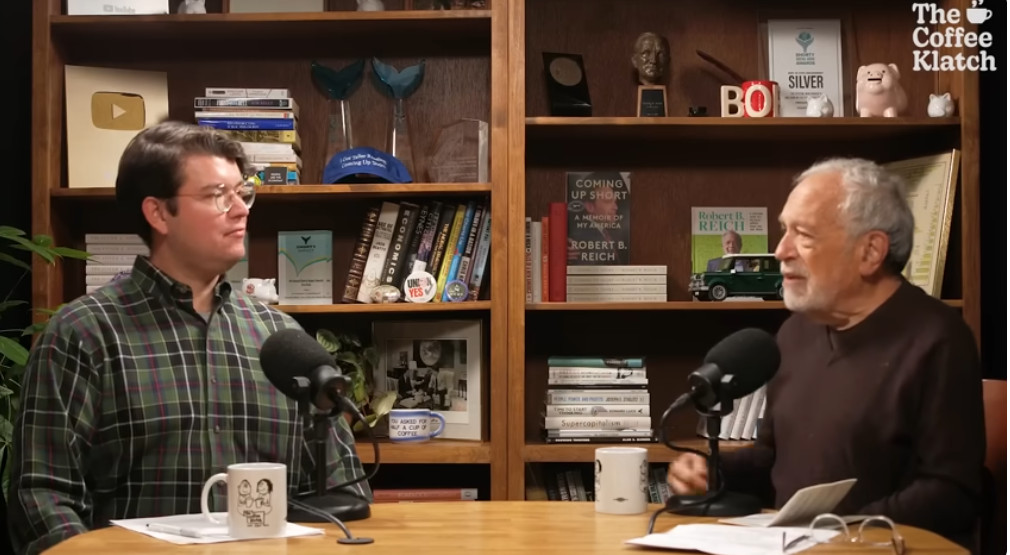
Original article: https://www.youtube.com/watch?v=MWJnsLYnaYA
Robert Reich and Inequality Media Civic Action
Premiered Sep 20, 2025
182,062 views ... 10K likes
The Coffee Klatch with Robert Reich
The silencing of Jimmy Kimmel isn't just about Trump's fragile ego.
It's also about the corporations who see the erosion of our rights as a simple cost of doing business.
Let's discuss Trump's war on free speech on today's Klatch.
More on October 18th No Kings Day: https://www.nokings.org
Peter Burgess COMMENTARY
Peter Burgess
Transcript
- 0:00
- And it is the Saturday coffee clutch with Michael Laannes Calderon. Hello Michael.
- Good morning Bob. How are you? It's good to see you. Uh Heather at Loft House is off today. Uh Michael, serious
- question. How are you doing? I've had better weeks to be quite honest with you. It is a scary time for a lot
- of people. I think I can't help talk about and and be aware of our age difference. I mean there's a
- half a century between us. Um, and I remember the I'm old enough to remember
- Joe McCarthy and the communist witch hunts of the 1950s and the fear people
- had to speak out, fear of uh of of ratting on each other, fear that somebody was going to submit their names
- to the government. Um, this feels a lot like that era. Now, you haven't been
- through that. I didn't I haven't lived through that. But I based on everything you've said on this program and to me personally, I think you're right. And
- it's been amplified, you know, by the power of the internet, right? Millions upon millions of people are participating in that culture in a way
- 1:06
- that they couldn't have in the 1950s. Well, but you are now in your late 20s.
- Um I mean, what's your dominant feeling? Are you are you frightened? Are you when you look ahead for the next 10 or 15 or
- 20 years um do you think oh my god this place is falling apart? This country is
- is not going to be put together again. I hope not is maybe what I'll say. And I think I try to cling to that hope. And
- it's been especially nice when there have been protests and gatherings of like-minded people to know that I'm not
- alone. Right. And even just talking with you, right? We're having the conversation openly. That's reassuring.
- Well, as long as we can conversation openly and um well, let's let's talk about what we are
- going to talk about and then we'll come back which I mean is related, right? I think everybody knows what the big news item
- this week is. It's the firing or rather the suspension of Jimmy Kimmel from his late night show on ABC and all of the
- 2:00
- consequences of that, the fear, you know, the possible retribution later on to other programs, the threats of that.
- uh and it's part of this broader crackdown on disscent, not just of specific groups like we've seen whether
- they're anti- or rather pro Palestinian protesters or immigrants, but anybody
- who has a dissenting viewpoint from the administration. Right. Well, from your standpoint, is this a continuation of
- the, you know, in the first eight months of the Trump administration going after
- universities, going after um museums and law firms and and the vindictiveness, or
- is this a different kind of thing? Have we turned a corner? Has Trump and his
- lackey, have they turned a corner? I mean, I think it's both, right? It's a continuation and a new phase as you've
- been saying on Substack and others other places as well. But I I don't know. I mean, I'm curious to ask you, you lived
- you you lived through part of the McCarthy area as as a young person, right? And the aftermath of that and you
- 3:03
- were telling me, you know, earlier that uh your generation actually had a big
- push back, right? The 60s. Everybody knows the 60s and culturally how different they were from the McCarthy
- era. Do you think that, you know, that's something that can happen again or is it coming? Like, do we see it already? Well, it it it is coming and it can
- happen again. Obviously, uh history, as has been said, doesn't repeat itself, but it does echo.
- Uh and this is an echo of something we've had before. Um you know, my memory
- goes back many years. I remember uh Thomas Jefferson at the constitutional
- convention. Oh, yeah. You were buds. Yes. He told me, Tommy, I used to call him. He said, 'You know, Bob, um, it's
- it's going to be rough to hold on to the First Amendment.' Um, and um, and Ben, he was right.
- And my friend Ben, he came back from France and he was the he was very excited about Yeah. interesting character that one
- France. But more seriously um yes in the last my
- 4:04
- purview of let's say 72 75 years um than I do remember um this is as bad as it
- gets as bad as it has got um but possibly worse Michael because you you
- have here a president who is uh a you know not all there I mean I
- think he is kind of a sociopath. Um, and very thin- skinned
- and a, you know, somebody who's a kind of malignant narcissist in terms of
- everything that somebody any criticism he takes extremely personally and he's
- very angry about any criticism. Uh and that combined with a group of people
- he's attracted around him who unlike his first term
- uh are simply magnifying and are eager uh to magnify and satisfy him and
- 5:03
- magnify all of his uh personality problems.
- And you know that includes u people like Steven Miller uh and uh Brendan Brendan Carr the FCC
- chairman um and uh obviously JD Vance and Russell vote and others. I mean you you there's
- kind of a a clubhouse quality to this. These are all men in their 40s.
- Uh they look to Trump for approval. They are competing among each other for
- Trump's approval. Uh they probably could not have made it uh in a real
- meritocracy outside of this administration uh because of their
- personality strangeness. I mean they really are odd people. Um but uh they
- can fulfill their ambitions through Trump. And so that's where some of the
- 6:01
- competition comes from. Uh that's why we see Brandon uh Carr, the FCC chair, doing things. You know, I have known FCC
- chairs before. Um can you name one? Yes. N um Mow.
- It's a good name. N Mow uh was FCC chair in the 19 early60s. Uh he became a friend. Uh he
- is famously remembered for those of us who remember New Mow uh as saying that
- television was a waste a vast wasteland. And why why was it a vast wasteland? This would have been the early 1960s,
- right? This was the early '60s. Well, this this has to do with McCarthyism actually because after the early 50s and McCarthy
- witch hunt, the whole nation uh became afraid at some level. I mean it was a
- kind of era of conformity uh and people hunkered down
- and I think that there is kind of a subconscious level to the United States
- to our polity uh in which uh there is a kind of a response to whatever is
- 7:06
- threatening the United States and what was threatening the United States was this fear of communism but also a fear
- of being identified as as strange or other or different
- u and that made the 50s an era of extraordinary conformity. Television
- reflected that conformity. So when N um I was going to say N Gingrich when N
- when N Mow said television was a vast wasteland he was saying you know there's
- nothing new there's nothing interesting there's no uh critical debate there's nothing here um and I think that in some
- ways the 60s the mid60s 667 was a response a backlash against that era of
- conformity uh and Now maybe we are seeing the
- backlash against the backlash. Yeah. I mean it it seems like that we're following a very similar pattern. I mean
- 8:04
- when you talk about Brandon Carr who has been called Trump's media bulldog, a title he wears proudly, you know, he's
- out there essentially threatening, right? That's how the the Kimmel firing happened. And maybe even let me take a
- step back because I think for people who maybe weren't following the story closely, why is this a First Amendment issue versus, you know, a corporate or
- business decision? Well, it's clearly a first amendment issue. And the first amendment I happen to have, you know, I carry my constitution round with me.
- There you go. The first amendment says congress shall make no law abridging the freedom of speech or of the press.
- Uh now Jimmy Kimmel uh even as a comedian uh is a social critic and some
- of our best comedy and some of our best social criticism are the same thing. Uh and Trump is aware of that. uh when
- Steven Colbear when his uh show was cancelled and it's going to go continue
- through May but it was cancelled uh by CBS uh at that time Trump says terrific
- 9:05
- I'm so glad Coar is gone Jimmy Kimmel will be the next one and certainly and
- ABC follows CBS uh the important thing to know here is that both CBS and ABC
- have a lot at stake They both uh had or have mergers that they would like
- approved. They're both uh trying to maximize shareholder returns. Um their
- boards of directors uh don't want uh the government to make you know make it more
- costly for them to operate. U so obviously when there is pressure on
- these networks u to squaltch free speech they will do it
- they will do it just simply as a matter of uh their feelings of of
- responsibility corporate responsibility to their shareholders and that's that's
- 10:02
- a new reality Michael that was not something that uh I was aware of in the
- 50s or 60s we now have much more consolidation of media and we have these
- gigantic corporations that are responsible. They have a fiduciary responsibility to their shareholders and
- so they're very sensitive to any government um you know making life
- difficult for them. Yeah. And I think in this specific case we had two clear examples of sort of uh
- a pretense, right? We had Trump's comments months ago about Kimmel. When you have a network and you have evening
- shows and all they do is hit Trump, that's all they do. If you go back, I
- guess they haven't had a conservative on in years or something, somebody said, but when you go back, take a look. All
- they do is they're not allowed to do that. Plus, car going on the news on or
- rather, excuse me, going on a conservative podcast. I mean, look, we can do this the easy way or the hard way. these companies can
- 11:05
- find ways to change conduct and take action frankly uh on Kimmel or you know
- there's going to be additional work for the FCC and saying you know Disney can we could either do this the easy way or
- the hard way and that's all Disney needed to hear. Yeah. The easy way or the hard way. Boom. That
- is the end. Yeah. And then the affiliates panicked or presumably you know they took action because of that. They pressured ABC. ABC
- made a call and that was it. Yeah. And that's uh so you have two of
- the big late night uh comedians. Yeah. Uh who have either been one Kimmel fired
- or not technically fired, cancelled. Uh the other one uh Steven Colbear uh sort
- of put on a very tight leash and he's leaving in May. Uh and then you know what's Trump's response to Kimmel's
- firing? He says, 'Well, now we have Jimmy Fallon and we have Seth.'
- 12:01
- Well, uh, look, I mean, this looks like it is a I don't want to say a plot or a
- plan. Uh, I don't want to be conspiracy- minded, uh, but, uh, clearly late night
- comedians and any criticism of Trump and again, you know, the tradition of late
- night comedians. I don't know if you saw David Letterman uh, just bits here and there. Okay. Well, uh, over the last couple of
- days, he's come out and he said, 'Uh, look, I for years would take on presidents.' I mean, I that's what I did
- at night at late night. Uh, well, late night comedy was about taking down the
- high and mighty uh to go after the It still is. It's still there. It's still around technically.
- Well, technically it is, but uh combine this with all of the other factors that
- is a media concentration. media that wants to concentrate even more and merge
- and acquire uh and shareholders that are making demands in terms of maximizing
- shareholder returns. And you get a tinder box uh and that tinder box is
- 13:04
- very easily inflamed by a president who is thin skinned and uh kind of his ego
- can't take any kind of criticism. Well, yeah. And I thought it was really well before I get into what Trump said
- this week because we often hear a million things that Trump says. I thought what Letterman said in his interview this week was interesting in
- that we all see where this is going. Managed media and this is something we've seen play out in Turkey, in
- Hungary, in Russia, especially in the early 2000s. There is a playbook and it's been played recently. We don't even
- have to look back to the 1930s for it. There is a playbook and um Trump and and
- and Russell V and all of the others they created remember they told us in before
- the election uh in project 2025 they told us what that playbook was
- and Brendan Carr was a co-author of project 2025 by the way okay important information he was a co-author of 2020 of the project 2025
- 14:03
- that was their playbook uh Trump said he didn't know anything about it but it was a playbook book that exactly paralleled
- the playbook of uh Victor Orban in Hungary. Uh someone who's attended a lot of American
- conservative political action conferences as well. Exactly. And one of the pieces of that playbook is to suppress criticism and to
- get control over the media. Uh now in a democracy and this is you know this all
- this context Michael this is all obviously about preserving democracy uh versus an authoritarian
- uh and an authoritarian movement that really does not want democracy.
- Yeah. Managed democracy maybe the illusion of democracy. Right. And the the other element here
- has to do with the billionaires who are buying up all these concentrated media
- outlets. Really, they're not just spending it on superyachts? No. No. I guess there's only so many super yachts you can buy before it gets
- 15:01
- boring. I mean, Larry Ellison, let's take for one example, he owns Oracle, which is that big software corporation, right?
- That's right. and his son David. Uh they are now effectively owners of CBS and
- they're now trying to buy uh CNN and Warner Brothers Discovery. Um
- the fact that we're even saying all these names that have already combined to some degree shows the degree of consolidation already.
- That's exactly right. And the the more consolidated it is uh the easier it is for the billionaires who are really the
- only ones to able to put this money together uh to buy. Uh and you have uh
- not only obviously Elon Musk with X uh you have Jeff Bezos u who has his own
- media uh conglomerate uh you know Amazon and the Washington Post and and other
- interests. Why is it that these billionaires uh you know America never
- had billionaires before but with wealth moving to the top we now have billionaires who are buying up these
- 16:04
- concentrated media outlets. Why are they doing it? Hello.
- I mean what do you think? I I think the reason is that because of concentrated wealth, because these billionaires own
- so much, they are frankly worried about majorities uh raising their taxes or
- taking their money away in some way. And so they're anti-majoritarian. They are anti-democracy.
- Um and and this is this is sort of psychology 101. Obviously, in a
- democracy, if you get too much wealth at the top, you're going to have people at the top who don't want it taken away by
- majorities, and they are going to they are going to move against democracy.
- Yeah. And I think it's interesting that you bring up Ellison in particular because we're sort of seeing the two-pronged alliance in action because
- my understanding is the FCC really only has statutory power over broadcast, which so that's the traditional
- 17:02
- networks, the cable networks, and so on. um or rather those using the public airwaves, excuse me. But you've also got
- the billionaires that are aligned with the Trump administration taking on the new media and social media. Right? So we saw Musk and X Ellison and a consortium
- of Silicon Valley people are trying to buy Tik Tok or rather have a sweetheart deal because of the Trump administration
- to take control. And that's a platform that we know has allowed a lot of disscent. I mean and Mark Zuckerberg has
- already bent the knee ages ago to allowing a free flow of disinformation to some degree on hit meta platforms.
- Exactly. And let's be very clear about this. The reason these billionaires want so much control over the media is
- because if they get that control, they can stifle disscent. They can make sure that certain ideas, certain opinions
- don't get through to Americans. Uh and therefore, democracy is not going to threaten their wealth.
- Yeah. And even if they're nominally opposed to the to the administration, because it's so concentrated in so few
- 18:00
- individuals, as you've said, I mean, what resistance can can be offered? Exactly.
- So, keep watching decentralized non-corporate funded media. Well, it does suggest that one of the if
- we ever get through this crisis, one of the responses has got to be to use antirust laws to not allow this degree
- of media concentration. Well, from your lips also to use tax
- laws did not allow this degree of wealth concentration. Well, I hope we get there. Um, but I did
- want to go back to what Trump said earlier this week because I thought it was also interesting to me because having now read and seen what Kimmel
- said, um, there wasn't a direct criticism of Trump himself. It was about the MAGA movement as a whole, which I
- guess you could say Trump believes he personifies as he also personifies America. But he spent all of this week
- talking about, you know, how much the networks and the evening shows went after him personally. And he even said,
- you know, about because Tam Pam Bondi, the AG, also said earlier this week, you know, we're going to go after people. Um, he's like saying people, you have
- 19:03
- hate in your heart. You know, ABC paid me $16 million for a form of hate speech. And I think it's really it's
- fascinating that he's redefined hate speech as any criticism of him. Well, it's also fascinating that these are the
- same people or many of the same people who uh just last year, in fact, up until
- 6 months ago were claiming that the left was cancelling
- uh and controlling speech, the you know, in the 2024 election, one of Trump's
- major themes was that he and the Republicans would protect free speech.
- Yeah. Uh and so there has been a complete 180 degree change from that
- position. It's now authoritarian 101. It's we are we don't want speech that is
- going to critical be critical uh of us. Uh and Pam Bondi should know better. I
- mean hate speech quote unquote is protected by the first amendment. The the Supreme Court has made it clear over
- 20:03
- and over again. You may not like uh hateful speech. You may not like
- somebody saying something that is awful uh about somebody else. Uh but that is
- protected speech. So I want to ask you another question related to that and how Trump interprets
- it because he's used personal defamation law quite a bit over his I mean his long
- career if you can call it that. Um could you tell us a little bit more about the implications of that now that he's
- president again? Well, this is actually a very important issue because no president has ever used defamation law
- uh as a weapon uh to stifle speech or to chill speech or to uh make various
- people anxious about what they say. Uh Donald Trump has used it. He used it
- against CBS. He used it against ABC. He's used it against the New York Times. He's use he's using it against the New
- York Times and the Wall Street Journal. uh he is uh mounting these lawsuits he
- 21:02
- has now ABC and CBS instead of fighting they would have won because the the
- standard under the Supreme Court's decision years ago New York Times versus
- Sullivan is that when you are a public figure a public official especially you
- have got to accept a lot of criticism uh you cannot get win a defamation suit
- unless you can show that there is uh want and disregard for the truth. Um that that there's a very high degree of
- uh it's not just negligence, but but actually you've got to show that uh the people who defamed you uh really knew
- that they were defaming you, knew that they were telling lies and actually did it despite that and were malicious uh in
- their intent. Well, that's a huge burden of proof. There's no way Donald Trump could have won against ABC or CBS.
- 22:00
- There's no way he can win against the New York Times or the Wall Street Journal. But ABC and CBS caved.
- Mhm. Now, this is analogous, Michael, to Columbia University caving or the law
- firms that caved in, surrendered to Donald Trump. You cannot surrender to a
- tyrant. If you surrender to a tyrant, you're just going to make that tyrant uh
- be more tyrannical and feel that that tyrant has more.
- They'll come back. They'll come back for more. There's no final surrender. That's right. Now, why did ABC and CBS
- surrender when they could have won so easily? Going back to our theme before, they
- have boards of directors who understand that it's all about dollars and cents. To them, it's not about the public's
- need to know or the public's right to know. It has nothing to do with the public interest. What they are concerned
- about is maximizing shareholder returns. And if they can get, you know, pay him 15-16 million to shut up and so they can
- 23:04
- get their mergers done and they can get everything else. Billions of dollars. Billions of dollars. That's a bigger that's extra zeros into
- an executive. It's an easy It's an easy cost benefit analysis. So, if you can do that, then
- of course pay him off. pay him off. Yeah. Which is it's all it's shakedowns all the way down.
- It's shakedowns all the way down. And remember Stephven Coar just days before
- he was essentially given notice that there will not be no another season of Cobar. He said it was a bribe.
- He called it just a bribe. The settlement by CBS.
- Uh which is not too different from what happened with Kimmel. I mean, for those who were following, maybe you know this,
- but one of the biggest affiliates that launched sort of the sequence of events had a merger in progress that's
- dependent on Brendan Carr saying, 'Yes, follow the money. Follow the money.' And Disney and ABC did too. They're
- trying to buy Fubo, which is a sports network. I mean, like you could for every one of these situations, there's
- 24:03
- exposure, which Trump will and his administration will always take advantage of. Trump will take advantage of any anything he possibly can to
- expand his power, his reach, his influence, and often his money. Uh but
- that's the problem. How do we fix it? Well, look, we talked a little bit about this. I mean you uh if we ever we that
- is the people are ever in power again you know antitrust laws have got to
- prevent that kind of media concentration and and and and defamation laws have to
- be changed. You a president should not be allowed to use defamation law uh to
- try to squatchch criticism. And for what it's worth, that New York Times case yesterday, we did get an update where it
- was I guess the the complaint was written so poorly that the judge kicked it back because it sounded too much like
- a truth social post. But notice that New York the New York Times is fighting. Yeah. Why is the New York Times fighting when
- 25:01
- ABC and CBS caved? Uh they're not trying to merge with the
- Washington Post, I guess. Well, there's also there's also a very prosaic reason. New York Times is not a
- public company. Mhm. It is not owned by it's not a public company that has shareholders. Uh it's a it's a familyowned company. So
- the Sberers who own New York Times can say essentially uh we don't care what
- you do. No, go to hell. Go to hell. Uh and that's something that CBS and NBC uh and and ABC felt that
- they could not do. So I guess I also want to ask in terms of the people, right? We have
- representatives in Congress right now. I mean talk outside of the corporate world, the business world. What, if
- anything, do you think Democrats as the opposition can be saying or promising
- for when when they return to power? Well, we've talked about several initiatives already. I won't repeat
- them, but I think the Democrats right now have got to say uh to Brendan Carr,
- to the FCC, you know, if we take over Congress uh in 2026, actually starting January
- 26:07
- 2027, uh we are going to make life impossible for you. Yeah. I mean, we are going to run oversight hearings. We are
- going to name names. We are going to make sure that you and people around you
- who are suppressing speech cannot do this anymore. And they're going to say, I I think it's going to be the same with
- regard to everybody else in the administration. You know, if you are playing essentially Victor Orban's
- authoritarian game, we're going to put a stop to this. And this is this has traditionally been the deterrent to
- overreach, right? I mean, going back the history of the republic, right? But why is it you think that why do the
- Republicans I mean, I have an answer in my head that I don't like, but why are Republicans acting like there won't ever
- be a a Democratic administration again or a Democratic Congress? Because to me, well, I know what you're thinking.
- You're think What are you thinking? What are you thinking? Well, I'm thinking that some of them think they have a sneaky plan to not allow Democrats to win the next election
- 27:03
- one way or another. Well, undoubtedly they do, and it's not so sneaky. I mean, they're already pursuing redistricting.
- Yeah. Uh, in red states, uh, and this is why it's so important that California,
- uh, vote in favor of redistricting, not as a race to the bottom. This is not
- a matter of blue states and red states racing to do more and more kind of uh
- redistricting that uh is essentially gerrymandering. Uh no, it's a it's a
- race and I think it should be a race by blue states to make it unprofitable,
- unfavorable. Um take away the the motive for red state governors to do this.
- Yeah. Um and uh it makes a lot of sense for California and other blue states uh
- to like Illinois should be doing this. I think um uh Maryland u you know West
- 28:06
- Moore and and JB Pritsker and other states blue blue states have said it and
- and need to say it clearly. We are going to meet you. We're going to counterbalance what you do. So there's
- no advantage to you red states in trying to squeeze out more seats in Congress.
- And I think it's also important, at least to me as a as a big fan of the rule of law and civil society and all of
- that that we're doing these things within the bounds of the rule of law. Right. Any consequences that Democrats promise are simply the application of
- existing law, which is something that Republicans, certain Republicans don't seem to fear anymore. Well, exactly. That's exactly right. Uh
- now remember also that you've got uh and Trump has and the administration has uh
- what is effectively a paramilitary operation uh under you know in the in
- ter in terms of ICE uh and they are picking up people off the street u because and they are
- 29:04
- stopping them uh using racial profiling. I mean, clearly the Supreme Court even
- in a bench opinion uh said that you can go ahead, you can stop people who have
- who look like they might be Latino. Uh well, this also creates in the body
- politic a kind of fear. U one of the underlying themes of this week is
- intimidation and fear. There is no way, Michael, uh, to measure the extent to
- which speech has been chilled. Uh, speech has been deterred, uh, by all
- of this in this environment. Uh, everything from the FCC going after Jimmy Kimmel, uh, to ICE and everything
- else that that Trump is doing with the universities. Um, we don't know because
- there you you you can't know what is not being said. Yeah. Uh but we have indications you
- 30:02
- know for example and we know that the people who are were in charge of 60
- Minutes on CBS uh they resigned. They left
- uh the people at the Washington Post who had been uh in many major positions of
- editorial writing and uh and columnists they quit they resigned. um you know the
- there is an indication of the degree to which um important things are not being said
- and not being part of the public conversation, the public square uh
- because of the chilling effect that all of this is having. Well, I also wanted to ask you about how that's playing out
- in our own lives locally, either here in Berkeley or elsewhere, because I think that for a lot of people, it really does
- feel like the walls closed in a little bit more this week, one way or another, where they know people in their
- communities that are being impacted or at their university or at their employer. Yeah, this is not just a theoretical
- 31:04
- discussion. This is real and it's happening right around us. Uh, and I think that when people see uh, you know,
- ICE agents interviewing or intimidating uh, their friends and people in their
- communities, when they see that here at Berkeley, for example, um, Berkeley, the
- university uh, that is committed presumably to free speech, uh, the free speech movement began here at Berkeley,
- University of California, Berkeley. Uh I was proud to and am proud to be you know a an a professor ameritus at Berkeley.
- Uh but this past week what did Berkeley do? It gave the names of 160 faculty and
- students and graduate students and lecturers who had been involved in
- protesting against Israel's role in Palestine. Uh and
- 32:00
- I mean why why well not only why uh but you we know in this environment some of those
- students have visas some of those lecturers have visas some of those people are very vulnerable some of the
- people who don't have tenure many of them are very vulnerable so why do you
- as a university where you have a responsibility to maintain freedom of speech and we're not talking about you
- know ABC news uh the you know responsibility to your shareholders or CBS responsibility to shareholders or
- you want to make a merger. No, we're talking about a university, a public university uh is giving the names of 160
- people in that university because the government demanded it. Chilling.
- Well, it's chilling and that is again part of the theme. It is a chilling effect. During the McCarthy era in the
- 1950s, uh, a lot of universities were asked to turn the names in of faculty
- members uh, who were communist sympathizers or communists, some
- 33:04
- universities said no. Many said yes. Yeah. And I think we're also seeing even
- beyond the actual administrators or you know executives what whatever you know that top level of leadership is being
- cowed into taking these kinds of actions. You're also seeing the right jinning up online mobs on X in
- particular that's being hasn't been moderated in a very long time. Um, even
- in, you know, the region where I grew up in Ohio, I'm hearing stories of teachers who were being recorded in classrooms
- and having, you know, very mild, in some cases opinions being shared online and harassed or in another case, I saw a
- woman who had pulled down some posters in her own apartment building doxed by a state representative. I a lot of these
- things are the very things that the right was complaining about or worried about, you know, if you're talking about the intellectuals, people who are in
- writing in the Atlantic and so on. And it's a complete about face and it's astonishing and obviously scary for a
- 34:02
- lot of people. Um, and as you said, chilling because now let me go back to your what you just
- said in your town. This is your town. You see it in your town. If it's in your town, it's in
- towns across America. If it's if it's in the University of California, Berkeley, it's in many places or is about to play
- be in many places around college campuses uh around America. Uh so isn't
- one of the responses you asked before, well what do we do about it? Isn't one of the responses that we as individuals,
- as members of our communities, uh as employees, as as participants in our
- towns, uh we make a huge stink that we demand that people's rights to speak, to
- express their opinions uh be respected. that we have something called called the
- first amendment the constitution uh and we are guardians of that not it's it's
- 35:00
- not just the people who are in the white house or people in congress all of us have responsibility to guard the first
- amendment well and I have I have a question about that free speech movement at the University of Berkeley you mentioned that happened in the 60s
- University of California Berkeley University of California Berkeley excuse me um if I'm remembering correctly I don't assume that the administrators and
- faculty at Berkeley were enthusiastic about it was mostly the students in the community, right?
- Yes. Well, it started uh because right after the uh summer of 1964
- uh when a lot of Berkeley students and other students went to Mississippi to register uh black voters
- uh and one of my friends was murdered, happened to be that summer, uh registering black voters. Uh when they
- got back from Mississippi, the Berkeley students set up tables uh to get more
- students to be involved in registering voters for the following summer. and the
- administration at Berkeley fearing and this goes right back to the McCarthy era, fearing the House unamerican
- activities committee and fearing the you know the kind of blowback from the
- conservatives and the Republicans and the right-wing uh in Congress they
- administrators of Berkeley said no you can't set up these tables you can't speak um you know at this university
- about what you want to do with uh with these uh you in in Mississippi. Well, that instigated
- a student demonstration that was the first takeover of an administration building in modern American history. Uh,
- hence the free speech movement, Mario Savio. Um, whose name do you remember
- Mario? Uh, you've told me about him before. Yeah. Well, everybody ought to know Mario Savio because he was one of the
- most articulate spokespeople, a student, a graduate student uh who said, 'Uh, no,
- this is this is inappropriate.' There's a time when the operation of the machine becomes so odious, makes you so
- sick at heart that you can't take part. You can't even passively take part. And
- you've got to put your bodies upon the gears and upon the wheels, upon the levers, upon all the apparatus. And
- you've got to make it stop. And you've got to indicate to the people who run it, to the people who own it, that unless you're free, the machine will be
- prevented from working at all. But he very powerfully and eloquently
- defended the free speech of students uh and uh that ultimately led to a victory
- for the students. Yeah. And that free speech movement spread around the country. Yeah. And that was from the bottom up,
- right? It was from the bottom up. The uh Yes. The attempt to squatchch to repress to
- suppress free speech was from the top down. That came from Joe ultimately originated with Joe McCarthy and the uh
- witch hunts. Uh no, it was it was the reversal. It was the pressure that came from the bottom up in this case from
- 38:03
- students uh that really did lead to the free speech movement and many of the
- guarantees that we take for granted today. And I'm sure the authors of that document would certainly agree. Nothing
- more American than the right to peaceibly assemble and express your opinion. No. Right. And and again, the first
- amendment talks about peaceable peaceibly assembling. I mean, I didn't get to that. the right no law, Congress
- will make no law abridging the freedom of speech of the press or the right of the people peaceibly to assemble.
- Now, uh again, Michael, we kind of take for granted the constitution or at least
- many of us took it for granted. We are now in the midst of you use the term
- right-wing. I don't think it's right-wing. I think it's not any right-wing that I ever
- experienced before. It's an authoritarian anti-democracy movement. Uh it's not left, it's not right. It is
- 39:04
- authoritarian versus democracy. That's really what's happening now. Uh and
- we've got to not only understand it, but spread the word. uh we've got to encourage people to be activists in
- favor of democracy against this kind of autocratic authoritarian movement.
- Well, I think that's a good segue into something that you all can do because October 18th, as some of you may already
- know, is the next No Kings Day protest. And I, for one, plan to attend whatever
- the local version of it is here in the East Bay. And even though I feel I mean
- certainly a little more nervous than I did a couple months ago, it's my right and I think people should ex exercise
- it. Well, suppose I think you're right obviously and I endorse uh that October
- 18th demonstration and people can find out, you know, you can find out where it
- is uh just by going to Do you have the address? We can put this up. We'll put it on the screen. on the
- 40:04
- screen. Uh just go to this particular link and you can find out where the most
- uh the nearest no kings demonstration is being organized around you. Uh but what
- I started to say was this business of intimidation. U some people have come to
- me, I don't know if they've come to you and said, uh look, I'm a little bit worried about demonstrating because my name, my image, uh my face, uh you know,
- I I don't want to lose my job. I don't want to jeopardize my future. Uh I
- certainly don't want to be subject to violence. Yeah. What do you say back? Well, kind of what I said a few moments
- ago that I'm also afraid to some degree to be honest, but I don't think I want
- that fear to consume me and I certainly don't want to be feeling it for a lot longer than we already have. Well, I
- think that just building on that democracy
- requires courage and I want to emphasize this word and
- 41:05
- maybe uh it's a good place to end on uh and that is simply to say that many
- of you are understandably scared,
- frightened at least demoralized. Some of you are depressed and desparing.
- I get it. I mean, I wake up in the morning and I think, 'Oh my god, I don't want to read the paper. I don't want to
- see what's going on.' We have a madman in the Oval Office surrounded by
- fanatics. It's scary.
- But this is exactly the time at which
- your involvement and activism and your courage are most
- needed. It's easy to take democracy for granted.
- 42:01
- It's easy to assume that this document,
- this constitution is in stone. It's not
- the people who have fought for this, died for this. My parents' generation
- that fought in World War II for this, they put their lives on the line.
- Now, I'm not saying you should put your life on the line or we need to put our lives on the line, but we need to at
- least have the courage to express our views, not be afraid
- to be clear about what our views are, have the courage to say to our employers, you should not be
- surrendering to the Trump administration. have the courage to boycott
- boycott companies that are surrendering to Trump and the authoritarians.
- 43:02
- We need to have the courage to organize and mobilize.
- This is not child's play and it is not theory.
- It is happening now and it's happening near you or maybe it's happening right
- at your place of work. So, Michael, I wish it could be a more upbeat ending,
- but this is serious stuff. It is. Thank you for joining us today.
- Grateful to be in community with all of you. Yes. Thank you. [Music]
- [Applause]
36:04
37:03